What is the multisensory audio-visual stimulation behind AvDesk?
It is a rehabilitation technique that presents the patient with spatially and temporally coherent visual and auditory stimuli, leveraging multisensory integration at the level of the superior colliculus. In this brainstem area, multisensory neurons respond with an intensity greater than the sum of the responses to the individual stimuli in isolation — a principle demonstrated by the foundational studies of Stein and Meredith. AvDesk applies this mechanism to activate cortical plasticity in support of the rehabilitation of neuro-visual and motor deficits.
Is AvDesk supported by scientific evidence?
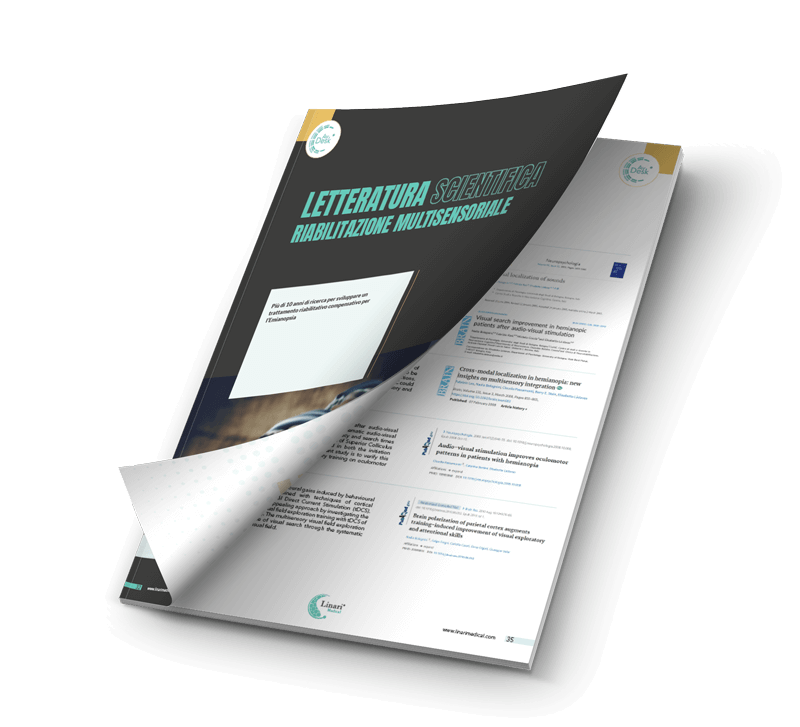
Yes. This page collects 21 scientific publications related to the multisensory stimulation behind AvDesk and to its clinical applications. The corpus includes original research articles, case reports, reviews, clinical studies and study protocols, published in peer-reviewed indexed journals, including Brain (Oxford University Press), Frontiers in Neurology, Frontiers in Neuroscience, Trials, Neuropsychologia, JOSPT Cases, JFMK and Orthopedic Reviews. Each entry reports authors, journal, year and a DOI or PMID identifier for direct verification.
Which clinical conditions are covered by the studies?
The studies on this page are organised into three thematic areas:
• Neuro-visual rehabilitation: hemianopia, unilateral spatial neglect, nystagmus, macular geographic atrophy;
• Motor rehabilitation: post-stroke recovery and rehabilitation following anterior cruciate ligament (ACL) injury;
• Neuroscientific foundations: multisensory integration and adult brain plasticity, which provide the theoretical basis of the method.
Can the multisensory training be delivered at home via telerehabilitation?
A feasibility study on the telerehabilitation of visual field deficits evaluated the applicability of the multisensory training at home under a clinician's remote supervision. The study verified the operational feasibility of the model, not a formal efficacy comparison with the in-clinic setting, which would require a dedicated comparative trial. The full reference, with DOI, is available in the "Neuro-visual rehabilitation" section.
What is the neuroscientific foundation of the method?
The method rests on two well-established pillars of neuroscience:
• Multisensory integration: Stein and Meredith showed that neurons in the superior colliculus amplify their response to visual and auditory stimuli when these are spatially and temporally coherent.
• Adult brain plasticity: the research of Lamberto Maffei documented the ability of the adult nervous system to reorganise itself in response to structured sensory experiences.
The foundational works are collected in the "Neuroscientific foundations" section.
Is multisensory stimulation also studied in motor and sports rehabilitation?
Yes. The "Motor rehabilitation" section collects publications on the application of multisensory stimulation to post-stroke recovery (including techniques based on 40 Hz gamma-band stimulation) and to neurocognitive and neuromuscular rehabilitation following anterior cruciate ligament (ACL) injury.
Some of these works address the underlying technique applied to sports and orthopaedic contexts, and are not necessarily clinical studies using the AvDesk device itself.
Who conducted the research?
The studies originate from collaborations between Italian and international research institutes and clinics. Among the groups recurring in the corpus:
• IRCCS Fondazione Stella Maris (Italy): an international reference in child neuropsychiatry (Tinelli, Purpura, Cioni);
• University of Milano-Bicocca (Italy): the group led by Nadia Bolognini, active in cognitive neuroscience, neglect and multisensory stimulation;
• University of Bologna (Italy): the group led by Elisabetta Làdavas, historically central to neuro-visual rehabilitation.
Full authors and affiliations are listed in each bibliographic entry.
Where can I access the original studies?
Each publication reports title, authors, journal, year and a DOI or PMID identifier linking directly to the original article on the publisher's website or on PubMed. The references are openly accessible for scientific verification.