longevity
AvDesk, the platform for cognitive longevity
Live longer. Live better. Keep your mind active.
Our medical device AvDesk combines multisensory stimulation and Physical AI to train processing speed and track its progress over time.
Longevity starts with the brain, too
When we think about prevention, we mostly focus on diet, physical activity, sleep, and cardiovascular health. They are all essential.
But there is another, equally important dimension: cognitive health.
Attention, memory, processing speed, concentration, and response time are functions we use all the time. They allow us to work, drive, make decisions, learn, and handle everyday activities.
Taking care of your brain means investing in your future, but also in your quality of life today.
The ACTIVE study in the United States
ACTIVE (Advanced Cognitive Training for Independent and Vital Elderly) is one of the most important research programs on cognitive training: 2,802 adults aged 65 and older at six sites across the United States, funded by the National Institutes of Health.
2,802
people
20 years
of follow-up
−25%
incidence of dementia diagnoses
With speed-of-processing training and booster sessions, compared with the control group.
Coe N.B. et al. (2026), Alzheimer’s & Dementia: TRCI · DOI: 10.1002/trc2.70197
The Linari Medical solution
What AvDesk can do
At Linari Medical, we develop technologies for multisensory stimulation and cognitive training. With AvDesk, we combine visual, auditory, and motor stimuli in interactive, customizable, and measurable exercises. Here is what it does, in every session and over time.

In every session
- Attention and responsiveness
Offers exercises that engage attention, processing speed, and response time: the functions you use to drive, work, and make decisions. - Multisensory stimulation
Lights, sounds, words, and movement in interactive exercises, coordinated in space and time. - Training that adapts to you
Exercises and difficulty levels adjust to your performance, with fast responses under divided attention. - An objective measurement in every session
Accuracy and response times are recorded trial by trial: you and your specialist see the trend right away, with objective charts. - At home or in the clinic
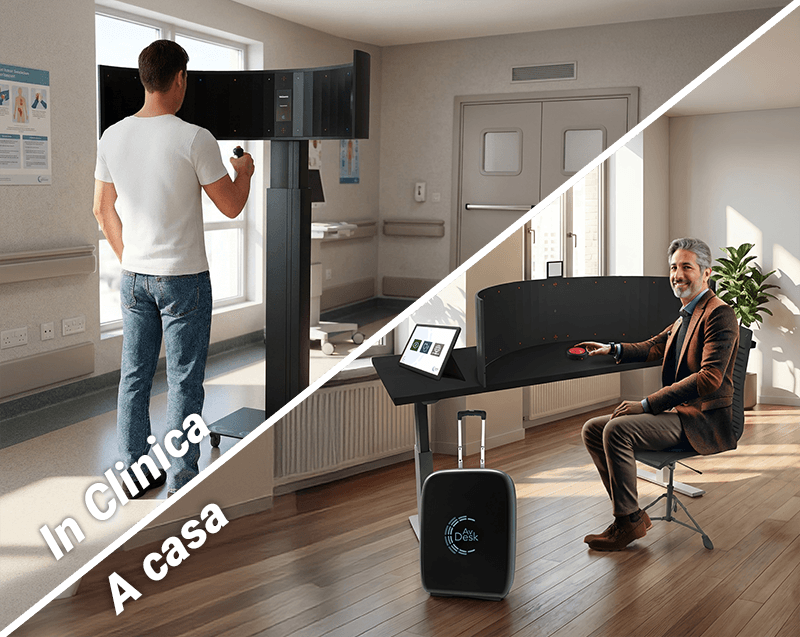
AvDesk Travel at home, AvDesk Lift in the clinic. Physical AI monitors gaze and posture and guides you into the correct position, while your specialist follows your program remotely.
Over time
- The features of the training studied in ACTIVE
The AvDesk task is fast, adaptive, and based on divided attention, like the speed-of-processing training evaluated in the ACTIVE study (the study was not conducted with AvDesk). - Programmable booster sessions
In the ACTIVE study, the long-term association emerged only with booster sessions. With AvDesk, the cloud records every session and lets you schedule boosters months or years later. - Your trajectory over time
The same measurement, repeated at set intervals, shows how your performance changes: compared with yourself, not with an average. - A program that can continue
AvDesk fits in a suitcase and sessions can also take place at home, so your program can continue over time without travel.
Long-term benefits refer to the literature on speed-of-processing cognitive training. No study has yet evaluated AvDesk as an intervention for dementia prevention.
Our vision is to make cognitive training increasingly accessible, measurable, and easy to integrate into brain health programs.
Brain Training
The brain can be trained
The brain has an extraordinary capacity to adapt, called neuroplasticity.
With the right experiences and stimuli, neural networks change over time. Brain Training relies on structured activities that engage specific cognitive functions.
Attention
Sustaining and allocating attentional resources.
Processing speed
Recognizing and processing stimuli quickly.
Response time
Responding promptly and accurately.
Memory
Practicing learning and recall.
Visual-motor coordination
Integrating perception, decision, and movement.
The goal is to stimulate these abilities with targeted, progressive, and measurable exercises.
Don’t train your brain only for the future.
Train it for today, too.
Cognitive longevity is not only about preventing decline. It is also about keeping your abilities in everyday life: staying alert, responding quickly, handling complex tasks.
Because quality of life also depends on what your brain allows you to do, every day.
Invest today
in your cognitive abilities
Want to learn how Linari Medical’s Brain Training programs and technologies work? Contact us to discover our solutions for cognitive training and multisensory stimulation.
Longevity is not just about adding years to life. It is about adding value to the years we live.
Looking for a program for yourself or a family member?
Find a center or specialist
The specialist assesses your profile and tells you whether and how to set up a program with AvDesk.
Frequently asked questions
If you have more questions, contact us.
Is AvDesk invasive?
No. AvDesk is a non-invasive Class I medical device: it delivers light and sound stimuli, with no drugs or electrical stimulation. Observed side effects are temporary and related to the effort of the session, such as concentration fatigue or dry eyes. People with epilepsy need a preliminary clinical assessment.
Is the program personalized?
Yes. It starts with an assessment test that measures reaction time, attention, and accuracy. The specialist sets the duration, distance, complexity, and position of the stimuli; during sessions, difficulty advances automatically based on your performance, and the plan adapts to the progress recorded in the cloud.
Does a doctor always need to be present?
No. At home, with AvDesk, you complete sessions on your own: Physical AI checks gaze and posture and guides you into the correct position, while the specialist sets up and follows your program remotely through Linari Medical Cloud. In the clinic, AvDesk Lift is used with the facility’s staff. In case of severe deficits, sessions should be carried out with the help of a caregiver.
When does it make sense to start?
The first signs of mild decline often appear between ages 45 and 65. Scientists point to ages 50–60 as the ideal window for prevention, but training remains useful after 65 as well.
Can it be done at home?
Yes. With AvDesk, the program takes place at home, while the specialist sets the protocol and follows the results remotely.
References
- Ball K. et al. (2002). Effects of cognitive training interventions with older adults: a randomized controlled trial. JAMA 288(18): 2271–2281.
- Bolognini N. et al. (2025). Telerehabilitation for visual field defects with a multisensory training: a feasibility study. Journal of NeuroEngineering and Rehabilitation.
- Coe N.B. et al. (2026). Impact of cognitive training on claims-based diagnosed dementia over 20 years: evidence from the ACTIVE study. Alzheimer’s & Dementia: TRCI 12(1): e70197. DOI: 10.1002/trc2.70197.
- Edwards J.D. et al. (2017). Speed of processing training results in lower risk of dementia. Alzheimer’s & Dementia: TRCI 3(4): 603–611.
- Rebok G.W. et al. (2014). Ten-year effects of the ACTIVE cognitive training trial on cognition and everyday functioning in older adults. J Am Geriatr Soc 62(1): 16–24.
- Willis S.L. et al. (2006). Long-term effects of cognitive training on everyday functional outcomes in older adults. JAMA 296(23): 2805–2814.
- World Health Organization (2015). World report on ageing and health. Geneva: WHO.
AvDesk is a non-invasive Class I medical device. The studies cited refer to cognitive training described in the literature and were not conducted with AvDesk, unless otherwise stated. Clinical case results are individual and cannot be generalized.