Nystagmus
Neuro-visual rehabilitation of nystagmus with multisensory audio-visual stimulation
What is nystagmus?
Nystagmus is a neuro-ophthalmological condition characterised by involuntary, rhythmic and repetitive eye movements. It can affect one or both eyes and takes on different phenotypes depending on the area of the nervous system involved: congenital, neurological (often associated with ataxias and neurodegenerative diseases) and vestibular. Its functional consequences are significant and affect vision, balance and mobility.
As the condition progresses, many patients develop a compensatory head posture in order to exploit the area in which ocular oscillation is least marked, the so-called null point or zone of least nystagmus. In these points, fixation is more stable, the image on the retina steadier and functional visual acuity improves.
Stabilising these fixation points is one of the main goals of neuro-visual rehabilitation.
Causes and functional impact
Nystagmus can be congenital, acquired or inherited. It is frequently associated with ataxias, neurodegenerative disorders characterised by progressive tremors, in which the genetic nature of the disease makes the available pharmacological treatments predominantly symptomatic. When nystagmus and ataxia coexist, functional deficits are marked, with progressive loss of autonomy in daily activities and walking.
In these complex clinical pictures, a multisensory rehabilitation approach, combining visual and auditory stimulation with proprioceptive and motor exercises, can complement drug therapy and restore dynamic stability and independent walking to the patient.
How AvDesk supports nystagmus rehabilitation
The therapeutic rationale for AvDesk in nystagmus rests on coincident audio-visual stimulation: light and sound stimuli are presented with controlled timing and patterns, and the patient responds to their perception. Repeated exposure to these carefully modulated stimuli fosters neuroplasticity and the reorganisation of the neural networks that regulate oculomotor and postural control.
More than 20 years of publications attest to the clinical efficacy of this approach in visual-field rehabilitation and in the enhancement of attentional and perceptual abilities, making AvDesk a versatile and reliable tool also for the treatment of nystagmus and other complex neuro-visual disorders.
The training protocol
The protocol published by the Neurorehabilitation Unit of the Azienda Ospedaliero-Universitaria Pisana (AOUP) provides for an intensive cycle organised as follows:
- 30 sessions of 2 hours each, 5 times a week;
- 1 hour of audio-visual sensory stimulation with AvDesk;
- 1 hour of proprioceptive exercises and motor conditioning;
- pre-treatment, post-treatment and 6-month follow-up assessments, both on and off medication;
- parameter monitoring with microperimetry (fixation-point stability measured with BCEA), Timed Up and Go, 10-Meter Walk Test, Berg Balance Scale and a quality-of-life questionnaire.
The AvDesk training is organised into seven exercise types of progressive complexity, which gradually challenge attention, multisensory integration and oculomotor control:
- Unimodal visual: recognition of visual stimuli (red and green) with no sound component, keeping the head still;
- Unimodal auditory: recognition of auditory stimuli with the gaze fixed on the centre;
- Focused crossmodal visual-auditory: coincident visual and auditory stimuli at varying levels of difficulty;
- Crossmodal visual-auditory mismatch: identification of decoupled sound and light stimuli;
- Bimodal tracking with triangular, quadrangular and linear stimulation patterns: recognition of stimuli following specific spatial patterns, with allowed eye movement.
The sessions are combined with motor tasks of varying difficulty to promote the transfer of sensory-stimulation benefits to everyday functional activities.
Clinical evidence
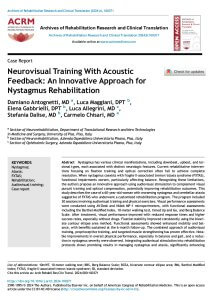
The efficacy of AvDesk in the neuro-visual rehabilitation of nystagmus is documented by a case study carried out at the Neurorehabilitation Unit of AOUP, under the supervision of Prof. Carmelo Chisari (Head of the Physical Medicine and Rehabilitation Unit) and Dr Damiano Antognetti, first author. The study involved a 60-year-old female patient with progressive nystagmus and ataxic tremors (consistent with FXTAS), on fampridine therapy.
Main results recorded at the end of the cycle and confirmed at the 6-month follow-up:
- improved visual fixation (BCEA), with more stable fixation points especially in the right eye;
- reduced response times to visual stimuli and increased success rate;
- increased postural stability and improved walking ability;
- more marked improvements in the off-medication condition, suggesting a stable neural adaptation independent of the immediate pharmacological effect;
- benefits maintained at 6 months, with the patient reporting recovered autonomy and psychological well-being.
Bibliographic reference:
- Neurovisual Training With Acoustic Feedback: An Innovative Approach for Nystagmus Rehabilitation — Antognetti D., Maggiani L., Gabbrielli E., Allegrini L., Dalise S., Chisari C. Archives of Rehabilitation Research and Clinical Translation, Volume 6, Issue 4, 2024, 100371, ISSN 2590-1095. DOI: 10.1016/j.arrct.2024.100371.
As this is a case study, the results are preliminary but encouraging and support the applicability of the protocol to different aetiologies of nystagmus (vestibular, neurological and congenital), in both hospital and outpatient settings, with supervised home-based pathways. To learn more, see the dedicated article and the scientific literature.
Frequently asked questions
If you have more questions, contact us.
What is nystagmus?
Nystagmus is a neuro-ophthalmological condition characterised by involuntary, rhythmic and repetitive eye movements. It can affect one or both eyes and takes on different phenotypes depending on the area of the nervous system involved: congenital, neurological (often associated with ataxias and neurodegenerative diseases) and vestibular. It frequently impairs fixation stability, balance and mobility.
What are the main forms of nystagmus?
The most common forms are congenital nystagmus (present from birth or the first months of life), neurological nystagmus (associated with central nervous system disorders such as ataxias and neurodegenerative diseases) and vestibular nystagmus (linked to labyrinthine and vestibular nuclei dysfunction). In every case, stabilising fixation is a key goal of rehabilitation.
Are there curative drugs for nystagmus?
The available pharmacological treatments — such as fampridine in neurological forms — can attenuate symptoms but do not resolve the condition and provide limited benefits over time. For this reason, neuro-visual rehabilitation combined with a motor programme represents a complementary, non-pharmacological strategy that can significantly improve autonomy and quality of life.
What does neuro-visual rehabilitation with AvDesk for nystagmus consist of?
AvDesk delivers a multisensory audio-visual stimulation training: light and sound stimuli are presented with controlled patterns and timing, and the patient responds to their perception. Repetition aims to foster neuroplasticity of the networks that regulate oculomotor and postural control, stabilising fixation points and reducing the functional impact of nystagmus.
What does the training protocol involve?
The protocol published in the AOUP case study includes 30 sessions of 2 hours each, five times a week: 1 hour of sensory stimulation with AvDesk and 1 hour of proprioceptive and motor exercises. Pre-treatment, post-treatment and 6-month follow-up assessments are performed both on and off medication. The training includes seven exercise types with varying visual, auditory and attentional complexity.
Is treatment with AvDesk invasive or painful?
No. The training is completely non-invasive, non-pharmacological and painless: it consists of observing visual and auditory stimuli in dim light and responding to them. It is considered safe even for fragile patients and can be tailored by the operator to the patient's clinical picture.
Can the training reduce dependence on medication?
In the AOUP case study, the most marked improvements were observed in the off-medication assessments. This suggests that the rehabilitation programme may enhance the patient's residual functional abilities and reduce the need for continuous pharmacological support, while always remaining integrated with the clinical pathway defined by specialists.
What clinical results have been documented?
The case study by the Azienda Ospedaliero-Universitaria Pisana (AOUP), published in Archives of Rehabilitation Research and Clinical Translation (2024), documented significant improvements in visual fixation (BCEA), stimulus response times, postural stability and walking ability, with benefits maintained at 6 months. As this is a case study, the results are preliminary but encouraging and support the replicability of the protocol across different aetiologies.
Schedule a free consultation with an AvDesk specialist
One of our specialists will call you back at your preferred time to explore the technical and scientific aspects of neuro-visual rehabilitation with AvDesk.