Post-stroke rehabilitation
Motor, sensory and attentional recovery after stroke with the multisensory audio-visual stimulation delivered by AvDesk Lift
Stroke is one of the leading causes of permanent disability in adults. Recovery of motor and sensory functions is possible, and the best outcomes are achieved when rehabilitation is early, intensive and personalised.
AvDesk offers a non-invasive and multisensory approach: through audio-visual stimuli modulated in intensity and frequency, it promotes neuroplasticity, cortical reorganisation and the coordinated recovery of motor, sensory and attentional functions.
What is a stroke?
A stroke (in Italian ictus cerebrale) is an acute condition caused by the interruption of blood supply to a portion of the brain. Nerve cells deprived of oxygen are damaged or die within minutes, with clinical consequences that depend on the affected area and on the extent of the lesion.
Two main categories are distinguished:
- Ischaemic stroke: accounts for about 85% of cases and is caused by the obstruction of a cerebral artery (thrombosis or embolism)
- Haemorrhagic stroke: caused by the rupture of a cerebral vessel, with blood extravasation into the brain tissue or the sub-arachnoid spaces.
85%
ischaemic stroke
65-76
years, average age
+30%
of patients with somatosensory-motor deficits
Incidence and impact on the patient's life
Stroke is the second cause of dementia and the third cause of death worldwide, with 5.5 million deaths every year and about 13.7 million new cases globally. In Italy, around 185,000 events are recorded each year (150,000 new episodes and 35,000 recurrences), with peak incidence between the ages of 65 and 75.
The functional consequences of stroke are wide-ranging and affect several domains at once:
- more than 30% of post-stroke patients present persistent somato-sensory and motor deficits
- neuro-visual disorders are also common (hemianopia, neglect), together with language, attention and executive-function impairments
- reduced autonomy in activities of daily living and in walking, with a significant impact on the quality of life of both patient and caregivers.
Motor recovery is fastest in the first 3-6 weeks after the event: starting an early and intensive rehabilitation within the neuroplastic window of opportunity is decisive to maximise functional recovery and reduce the risk of permanent deficits.
The limits of traditional rehabilitation
Despite the wide availability of rehabilitation techniques (physiotherapy, occupational therapy, electrical or vibratory stimulation, neuromuscular taping, robotic therapy, virtual and augmented reality), clinical outcomes often remain suboptimal:
- 50-70% of patients still present permanent deficits at the end of their rehabilitation programme;
- up to 30% of patients show a mismatch between motor and sensory recovery: the proprioceptive and discriminative component remains impaired even when muscle strength improves;
- the most effective techniques (robotics, virtual reality, multisensory integration) require long treatment times (12-24 weeks), high costs, strong personalisation and an accessibility that is often limited to major rehabilitation centres.
Hence the need for a scalable, personalisable and clinically validated approach, integrating motor and sensory recovery in a single training session.
The scientific rationale: multisensory stimulation at specific frequencies
The latest literature in rehabilitation neuroscience, with contributions from research groups such as those of John Krakauer (Johns Hopkins University), Leonardo G. Cohen (National Institute of Neurological Disorders and Stroke), Ladan Shams (UCLA Multisensory Perception Laboratory) and Stefano Paolucci (Fondazione Santa Lucia IRCCS), converges on a key principle: when delivered in a structured way, multisensory stimulation enhances the neuroplasticity mechanisms that drive post-stroke recovery.
55%
significant improvements
65%
clinically relevant improvements
72.5%
motor-function improvement at 3 months
Summary figures from the literature:
- 55% of patients treated with non-invasive brain stimulation combined with cognitive/motor training show clinically significant improvements
- 65% achieve meaningful improvements in muscle strength and sensory discrimination with an integrated neurocognitive approach
- 72.5% improve their motor function at 3 months by combining pharmacological treatment with frequency-specific stimulation.
The common thread of this evidence is the specific frequency of the stimulation. By modulating audio-visual stimuli it is possible to induce cortical oscillatory patterns associated with different functions:
13-30 Hz
beta waves
preparation and control
of voluntary movement
~40 Hz
gamma waves
multisensory integration, focused attention and perceptual binding
Stimulation in the gamma-beta band helps to reduce the mismatch between motor and sensory recovery, promoting a coordinated restoration of the neural networks involved in the control of motor gestures.
How AvDesk Lift supports post-stroke rehabilitation
AvDesk Lift is the version of AvDesk designed for rehabilitation gyms, physiotherapy clinics and neurorehabilitation centres.
It features a height-adjustable audio-visual stimulation panel, a feedback button to record the patient's response and an artificial intelligence system that continuously monitors head positioning and attentional level during the session.
In post-stroke rehabilitation, AvDesk Lift is used to:
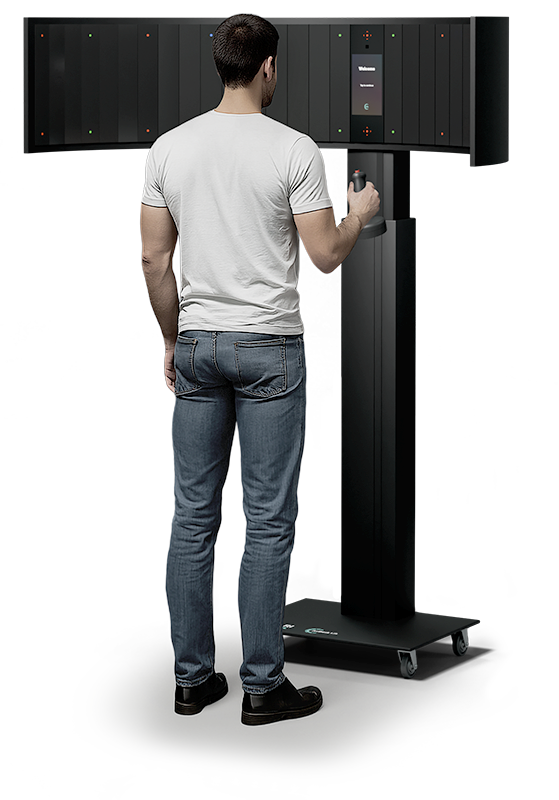
- deliver single or combined audio-visual stimuli whose intensity and frequency can be tuned to the patient's clinical picture
- carry out motor tasks such as grasping, reaching, static and dynamic balance in synchrony with the sensory stimulation, integrating sensory and motor training within a single session
- work in the beta band (13-30 Hz) to support motor preparation and in the gamma band (~40 Hz) to enhance multisensory integration and attention
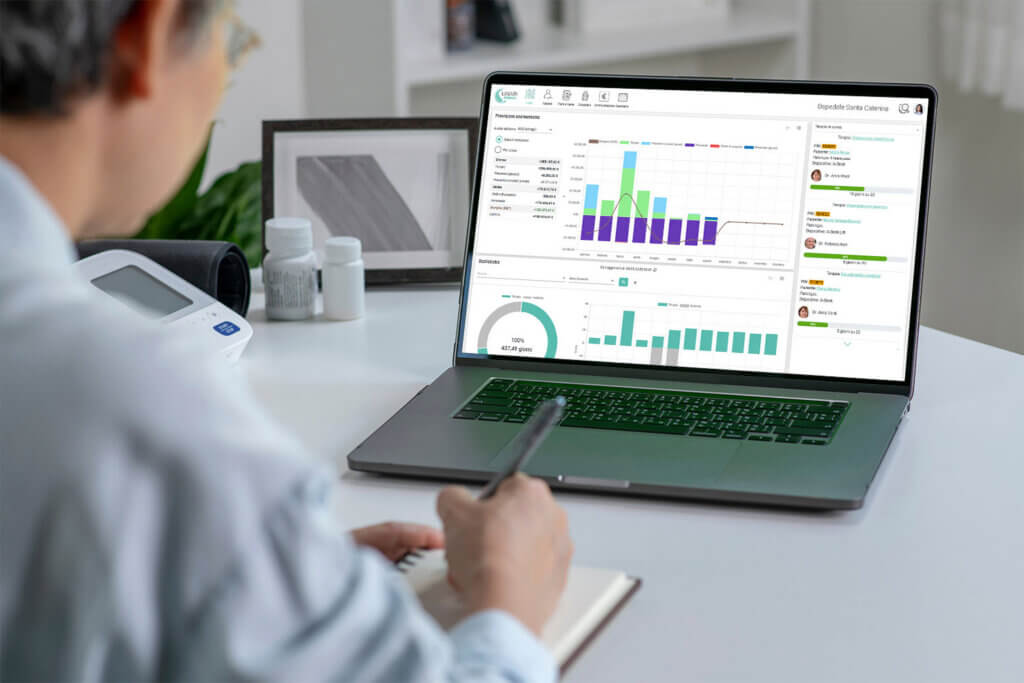
- manage each patient's therapy plan through the Linari Medical Cloud, with real-time consultation of stimulation parameters and outcomes
- monitor the patient's attentional level and automatically re-calibrate the stimulation thanks to the integrated eye and face tracking system.
The result is a non-invasive, painless and fully personalisable rehabilitation pathway, integrating motor recovery, sensory recovery and focused-attention training in a single clinical workstation.
Structure of the therapy
The AvDesk Lift protocol for post-stroke rehabilitation is organised into stimulation cycles alternated with rest phases, according to parameters that can be adjusted by the specialist:
- stimulation duration (t) and rest duration (t*): variable depending on the patient's tolerance and on the therapeutic goal
- single light-pulse duration (t') and interval between pulses (t*'): set in milliseconds to obtain the desired frequency
- input repetition frequency (f): adjustable to work in the beta or gamma band
- number of cycles (n): configurable for each individual session.
On this grid of parameters, the operator builds exercises of increasing complexity, alternating motor tasks with attentional tasks and coincident multisensory stimulation, so as to promote the consolidation of the new neural networks and the retention of results over time.
Clinical goals of the rehabilitation programme
- recovery of motor skills and independence in activities of daily living
- sensory recovery (proprioception, tactile discrimination, visual and auditory integration)
- improvement of focused attention and of the executive functions that support movement
- stimulation of beta and gamma brain waves to enhance neuroplasticity mechanisms
- consolidation of neural readaptation, in order to preserve the benefits achieved during training over time.
Scientific evidence and ongoing trial
Visual-auditory stimulation in the gamma band at 40 Hz is the subject of a randomised clinical trial on acute-phase limb motor rehabilitation after stroke, whose protocol has been published in the peer-reviewed journal Trials (Springer Nature - BioMed Central):
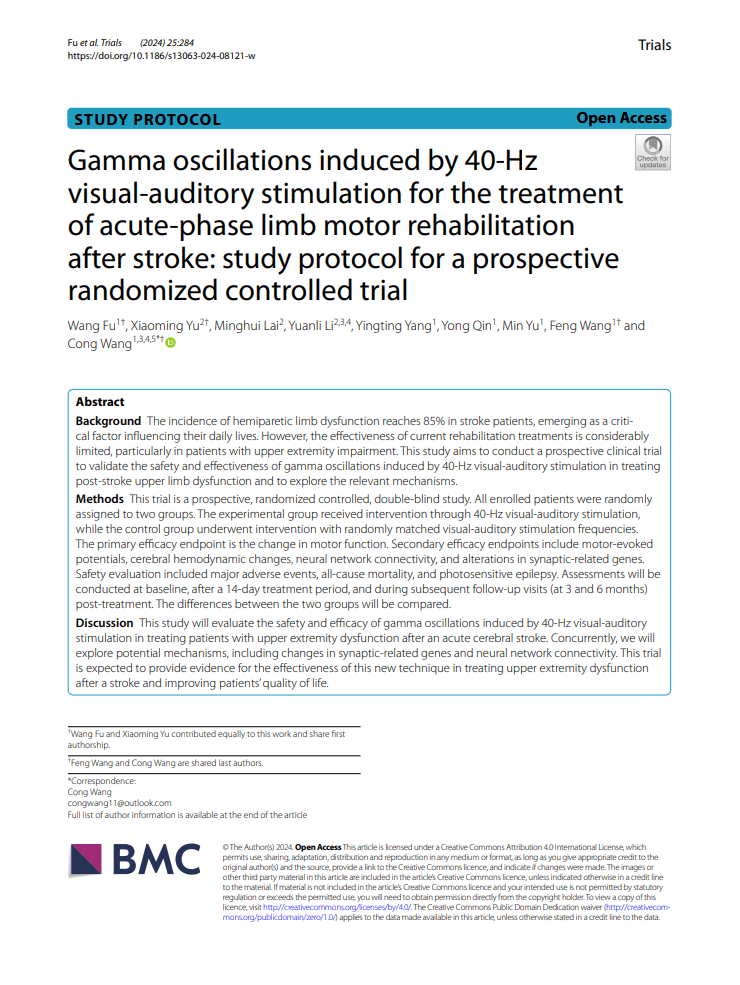
Gamma oscillations induced by 40-Hz visual-auditory stimulation for the treatment of acute-phase limb motor rehabilitation after stroke: study protocol for a prospective randomized controlled trial
Fu W., Yu X., Lai M. et al., Trials 25, 284 (2024). DOI: 10.1186/s13063-024-08121-w.
The study includes:
- 14 days of stimulation with 25-minute sessions (12 cycles of 1 minute of stimulation alternated with 1 minute of rest)
- follow-up at 3 and 6 months
- two groups: the experimental group receives 40 Hz audio-visual stimulation, while the control group receives audio-visual stimulation at random frequencies.
The primary objective is to verify the efficacy and safety of gamma stimulation on motor recovery.
The AvDesk multisensory approach fits within a solid body of peer-reviewed literature on post-stroke neuroplasticity and on audio-visual integration as a driver of motor and sensory recovery.
More than 20 years of publications support the effectiveness of multisensory stimulation in neurorehabilitation, from visual-field deficits to complex post-stroke syndromes.
Further reading
- AvDesk Lift: multisensory neurorehabilitation medical device for hospitals, care facilities and rehabilitation gyms.
- Scientific publications: peer-reviewed literature on AvDesk and multisensory stimulation.
Frequently asked questions
If you have more questions, contact us.
What is post-stroke rehabilitation and why is it so important?
Post-stroke rehabilitation is the therapeutic pathway that helps patients recover the motor, sensory, attentional and communicative functions impaired by a stroke. It is decisive because more than 30% of patients develop persistent deficits and 50-70% still present sequelae at the end of traditional pathways: an early, intensive intervention that leverages the brain's neuroplasticity is the most effective strategy to contain disability and restore autonomy.
When should rehabilitation start after a stroke?
Motor recovery is fastest during the first 3-6 weeks after the event, within the so-called neuroplastic "window of opportunity". Starting early, with intensive and personalised sessions, maximises functional recovery and reduces the risk of permanent deficits. Rehabilitation continues into the sub-acute and chronic phases, with goals gradually focused on maintaining results and on autonomy in activities of daily living.
How does the AvDesk Lift approach differ from traditional rehabilitation?
Traditional techniques (physiotherapy, occupational therapy, electrical stimulation, robotics, virtual reality) are effective but often require long treatment times (12-24 weeks), are costly and accessible only in major centres. AvDesk Lift integrates frequency-specific audio-visual sensory stimulation and synchronous motor tasks within a single session, delivering a non-invasive, painless and fully personalisable pathway designed to reduce the mismatch between motor and sensory recovery.
What is multisensory audio-visual stimulation?
It is a non-invasive technique that presents the patient with light and sound stimuli that are coincident in time and space, modulated in intensity and frequency. Activating the visual and auditory pathways in a coordinated way enhances the neuroplasticity and cortical reorganisation mechanisms that support the recovery of motor control, proprioception, sensory discrimination and focused attention.
What does it mean to work in the beta and gamma bands?
Beta and gamma are two brain oscillation bands associated with different functions. Beta-band stimulation (13-30 Hz) supports the preparation and control of voluntary movement. Gamma-band stimulation (around 40 Hz) supports multisensory integration, focused attention and perceptual binding. AvDesk Lift allows the stimulus frequency to be modulated to work in either band, according to the patient's therapeutic goals.
Is treatment with AvDesk Lift invasive or painful?
No. The training is completely non-invasive, non-pharmacological and painless: the patient observes light and sound stimuli in front of the device and responds with a feedback button, while the artificial-intelligence system monitors head positioning and attentional level. It is considered safe even for fragile patients and can be recalibrated in real time by the operator based on clinical tolerance.
Which patients is it intended for and in which facilities is it used?
AvDesk Lift is intended for adult patients in the sub-acute or chronic post-stroke phase, with motor and/or sensory deficits of the limb and of postural control, including those with neuro-visual comorbidities such as hemianopia and neglect. It is used in rehabilitation gyms, physiotherapy clinics, hospital neurorehabilitation units and care facilities, where the clinician builds a personalised therapy plan and monitors its progress through the Linari Medical Cloud.
What scientific evidence supports the AvDesk approach in post-stroke rehabilitation?
The efficacy of multisensory stimulation in neurorehabilitation is supported by more than 20 years of peer-reviewed publications on AvDesk and by a solid body of international literature on post-stroke neuroplasticity. In particular, the 40-Hz audio-visual stimulation protocol is the subject of an ongoing randomised clinical trial (Fu et al., Trials 25:284, 2024), designed to verify its efficacy and safety on acute-phase limb motor recovery.
Schedule a free consultation with an AvDesk specialist
One of our specialists will call you back at your preferred time to explore the technical and scientific aspects of neuro-visual rehabilitation with AvDesk.